Left Brain vs Right Brain: What's the Difference? (Quiz)
Are you left-brained or right-brained? What neuroscience actually says about lateralisation, split-brain research and the personality myth — plus a free quiz.
Published 2026-10-25 · Updated 2026-10-25 · Brain Function Quiz
You have seen the posts: 'left-brained people are logical, right-brained people are creative — take this test to find out which one you are.' It is one of the most shared ideas in pop psychology. It is also mostly wrong.
This guide explains what is real about left and right brains, what the famous split-brain experiments actually showed, and why no quiz can sort your personality into a hemisphere. Then you can take our quiz — which tests the science, not the myth.
The popular idea
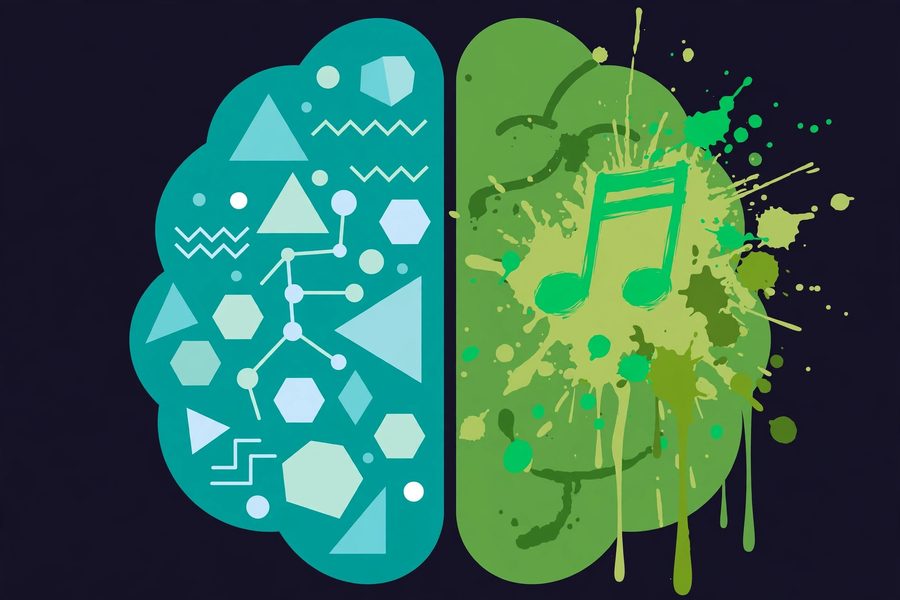
The myth goes like this: the left hemisphere handles logic, maths and language, the right handles creativity, intuition and art — and each person is dominated by one side, which explains their personality. It is neat, it feels true, and it sells a lot of personality tests. The problem is that brain imaging has never found it. When people do logical tasks or creative tasks, networks light up across both hemispheres. You do not think with half a brain.
What neuroscience actually found
Something real sits underneath the myth: lateralisation. Some functions do lean to one side. In about 95% of right-handed people, language is controlled mainly by the left hemisphere — Broca's area (speech production) and Wernicke's area (comprehension) both sit on the left. Spatial processing, like reading a map or recognising faces, leans right. But 'leans' is the key word: the other hemisphere still contributes, and the two sides constantly share information through the corpus callosum, a band of about 200 million nerve fibres.
The split-brain experiments
The strongest evidence came from an extreme situation. In the 1960s, surgeons cut the corpus callosum in patients with severe epilepsy, to stop seizures spreading from one hemisphere to the other. Roger Sperry and Michael Gazzaniga then tested these 'split-brain' patients and found each hemisphere could work on its own: show an object only to the right hemisphere and the patient could point to it with the left hand — but could not name it, because speech lives in the left. Sperry shared the 1981 Nobel Prize in Physiology or Medicine for this work.
So which side are you?
Neither — and that is the honest answer. You are not left-brained or right-brained; you are both-brained, with some functions leaning one way. A quiz that claims to diagnose your dominant hemisphere from ten questions is entertainment. A quiz that teaches you lateralisation, split-brain research and the myth itself — that is the one on this page.
 Now test yourself →⚖️ Left Brain vs Right Brain Quiz — free, adaptive, no signup
Frequently asked questions
Are people really left-brained or right-brained?
No. Brain imaging shows creative and logical tasks use networks across both hemispheres. Some functions are lateralised, but personality is not.
Which side of the brain controls language?
Usually the left hemisphere in most right-handed people — Broca's and Wernicke's areas sit on the left.
What is the corpus callosum?
A thick band of about 200 million nerve fibres connecting the two hemispheres so they can share information.
What did the split-brain experiments prove?
That each hemisphere can work independently when separated — and that speech, in most people, lives in the left hemisphere. Roger Sperry won the 1981 Nobel Prize for this work.