Brain Anatomy Quiz: Parts, Lobes and Functions Explained
Learn the parts of the brain — lobes, cerebrum, cerebellum, cranial nerves and blood supply — then test yourself with our free brain anatomy quiz.
Published 2026-10-25 · Updated 2026-10-25 · Brain Function Quiz
The brain weighs about 1.3–1.4 kg, uses roughly 20% of the oxygen you breathe, and runs everything from your heartbeat to your homework. This guide covers the anatomy students actually get tested on — the lobes, the big parts, the cranial nerves — and then you can prove you learned it in our free brain anatomy quiz.
Every fact below appears as a question in the quiz, with a one-line explanation after each answer. Read once, then play a round.
The four lobes at a glance
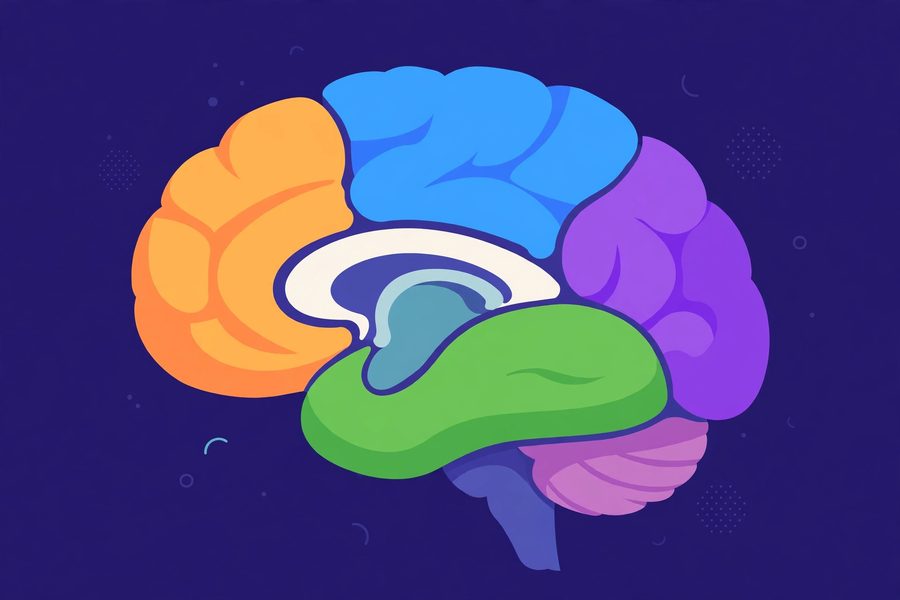
Each hemisphere of the cerebrum is divided into four lobes. If you remember one line per lobe, you already know half of most anatomy quizzes:
- Frontal lobe — planning, decision-making, personality and producing speech (Broca's area lives here).
- Parietal lobe — touch, spatial awareness and knowing where your body is in space.
- Temporal lobe — hearing, memory and understanding language (Wernicke's area lives here).
- Occipital lobe — vision. It sits at the very back and processes everything your eyes send it.
The big parts and what they do
Beyond the lobes, five structures come up in almost every brain anatomy quiz. The cerebrum is the largest part — about 85% of the brain's weight — and handles thinking, memory and voluntary movement. Underneath it at the back sits the cerebellum, the 'little brain', which fine-tunes balance and coordination. The brainstem (midbrain, pons and medulla) keeps the automatic jobs running: breathing, heartbeat and sleep cycles.
Deep inside, the thalamus acts as a relay station — almost every sensory signal passes through it on the way to the cortex (smell is the exception). The hypothalamus, just below it, links the nervous system to hormones and controls hunger, thirst and body temperature.
Cranial nerves in 30 seconds
There are 12 pairs of cranial nerves, numbered I to XII. They carry signals directly between the brain and the head, neck and torso — no spinal cord involved. The ones quizzes love most are the optic nerve (II, vision), the trigeminal nerve (V, face sensation), the facial nerve (VII, facial expression) and the vagus nerve (X), the longest of them all, which wanders down to the chest and abdomen. 'Vagus' means 'wandering' in Latin, and it is a free point in any anatomy quiz once you know it.
Why students love the sheep brain
Sheep brains are a classroom classic because they are cheap, available and structurally very similar to ours — same lobes, same cerebellum, same brainstem. The main differences are size and surface: a human cerebrum is much larger, especially the frontal lobe, and far more folded. In a dissection, the first thing you meet is the dura mater, the tough outer membrane that protects the brain. Our quiz includes sheep-brain questions, so dissection students can test the same facts they will see in the lab.
How to use the quiz to study
Play a 10-question round, read every explanation — even for answers you got right — and then play again. The difficulty adapts: get a streak going and the questions get harder, fail a hard one and the next is easier so you recover. If the start feels too easy, tap Hard (skill 7.5) before your first question and you will be tested on vagus nerves and the Circle of Willis from the first minute.
 Now test yourself →🧠 Brain Anatomy Quiz — free, adaptive, no signup
Frequently asked questions
How many lobes does the brain have?
Four per hemisphere: frontal, parietal, temporal and occipital.
What is the largest part of the brain?
The cerebrum — about 85% of the brain's weight.
How many cranial nerves are there?
12 pairs, numbered I (olfactory) to XII (hypoglossal).
Is the brain anatomy quiz free?
Yes. No signup, no login — 10-question rounds, adaptive difficulty, instant feedback.